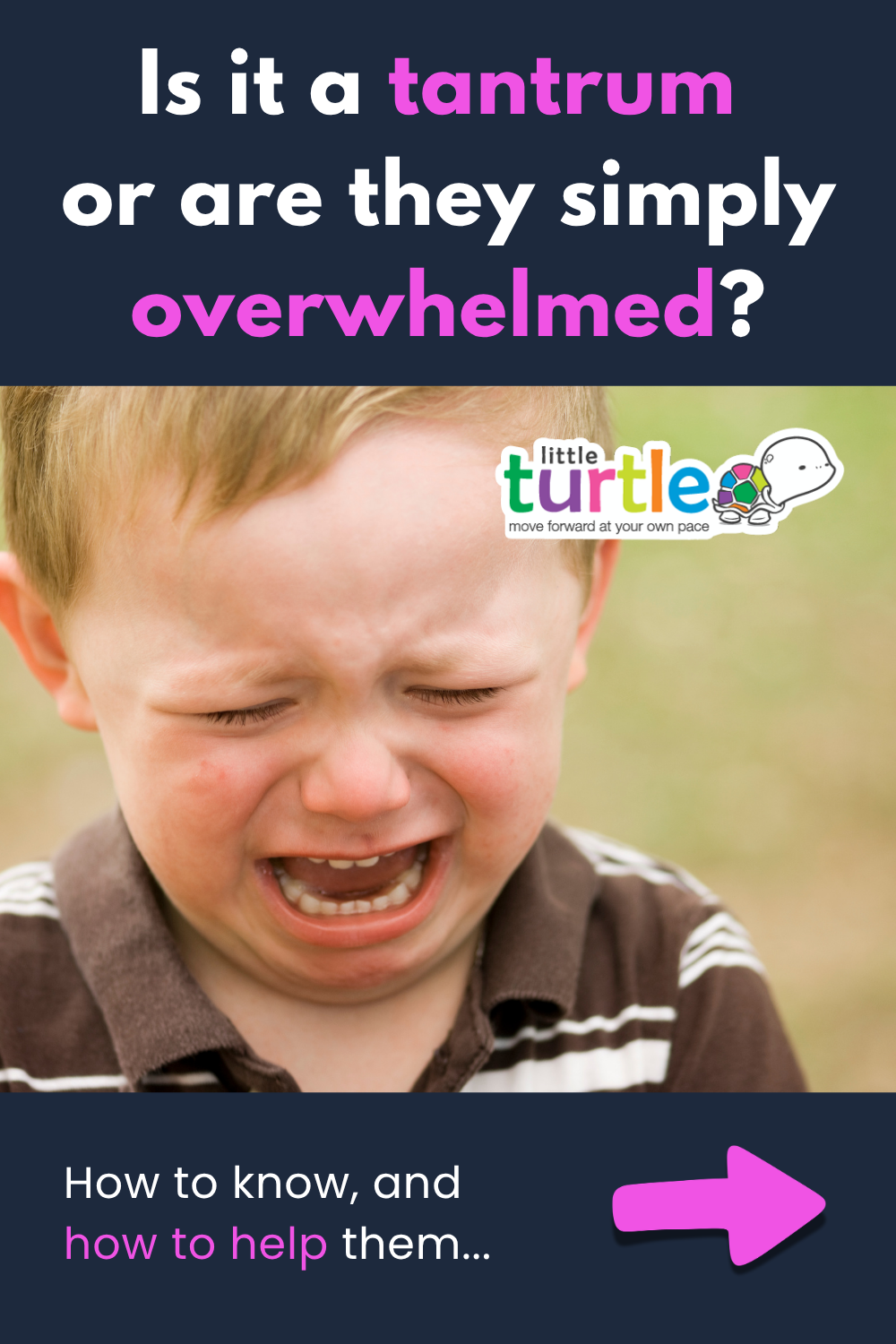
Is it a tantrum or is it an overload that they can't control?
Tantrum
- Goal directed - they want something specific
- They've been told 'no'
- They check for an audience
- They make eye contact or pause
- Stops relatively quickly
What a tantrum actually is
A tantrum is goal-directed. Somewhere underneath the noise, your child wants something — a toy, five more minutes, the blue cup instead of the red one — and they haven’t yet got the tools to handle “no” calmly.
It’s frustration, and it’s very normal, especially in younger children who are still learning that feelings pass and boundaries hold.
Signs you’re likely looking at a tantrum:
- It started right after being told “no,” or not getting their way
- There’s an audience effect — it’s often louder when you’re watching, and eases when you walk away or stop reacting
- Your child can still make eye contact, or pauses to check your reaction
- It tends to stop relatively quickly once the boundary is calmly held, or once they’re distracted
- Afterwards, they bounce back fairly normally
What tends to help:
- Stay calm and hold the boundary — caving teaches that the tantrum works, which isn’t a criticism of your child, just how learning works
- Name the feeling without giving in to the demand: “You’re really cross you can’t have that right now.”
- Offer a genuine, small choice where you can, so they get some control back without you moving the actual boundary
- Praise the calm moments, not just manage the loud ones
Overload
- No obvious trigger
- Physical signs
- Don't look for audience
- Reasoning doesn't work
- Takes long time to settle
What sensory overload actually is
This is a different thing altogether, and it’s NOT about wanting something. It’s what happens when noise, light, texture, unexpected touch, a change of plan, or simply too much everything has built up past what your child’s nervous system can process. It’s involuntary — your child isn’t choosing this, and in the moment, the part of their brain that can reason and negotiate isn’t the part that’s currently steering.
This is far more common in neurodivergent children, and in children with sensory processing differences, but any child can hit this wall under the right (or wrong) circumstances.
Signs you’re likely looking at sensory overload, not a tantrum:
- It doesn’t map neatly onto being told “no” — it can start with no obvious trigger, or build slowly over a whole day before “exploding” somewhere unrelated
- Physical signs: covering ears, flapping, rocking, gagging, going rigid, trying to bolt, or sudden crying that seems out of proportion to what just happened
- Little to no audience-checking — they’re not looking to see your reaction, because right now they’re not really with you in that way
- Reasoning, bargaining or distraction don’t work and can sometimes make it worse
- It can take a long time to properly settle, and your child may seem drained, foggy, or need quiet long afterwards rather than bouncing straight back
What tends to help:
- Safety first, not calm first — get them away from anything that could hurt them, not toward “stopping” the reaction
- Reduce input rather than add it: dim lights, quieter space, remove the scratchy jumper, turn down the noise — whatever’s realistic in the moment
- Stay close without demanding eye contact or conversation — some children need you right there, others need space; you’ll learn which is which for your child
- Save any talking, explaining or reflecting for well after things have settled — not during
There’s a particular kind of exhausted that comes from not knowing which battle you’re actually in. Is this a “no, you can’t have that” tantrum — the kind that ends the second you hold your ground? Or is this something else entirely — your child’s body reacting to something that’s simply become too much, in a way they have no control over at all?
Getting this wrong isn’t a failure. Both can look loud. Both can look like your child has “lost it.” But they come from completely different places, and handling them the same way often makes the wrong one worse.

The quickest way to tell them apart?
If you only remember one thing: ask whether removing the “no” would fix it. If your child would calm down the instant they got the toy/screen/snack, you’re almost certainly looking at a tantrum. If there’s no “yes” that would fix it — if it’s about the room being too loud, not about a decision you made — you’re looking at overwhelm, and it needs a completely different response.
Why this distinction actually matters
Treating overwhelm like a tantrum — holding a firm boundary, waiting it out, expecting them to “snap out of it” — doesn’t teach a lesson. It extends something your child had no control over in the first place, at a moment when they’re least able to learn anything at all. And treating every tantrum like a meltdown, tiptoeing around ordinary frustration, can make it harder for your child to build the tolerance they’ll eventually need for life’s ordinary “no’s.”
Neither mistake means you’re a bad parent. This is genuinely hard to read in the moment, especially when you’re tired, in public, or running late. Give yourself the same grace you’re trying to give your child.
If this is a regular part of your life
If sensory overload is something your child experiences often, having something ready before it happens — rather than figuring it out mid-crisis — makes a real difference. That’s exactly why we put together the Meltdown Script Cards: short, practical prompts for the moment it’s happening, and gentle scripts for afterwards, built the same way as everything else on Little Turtle — from lived experience, not a textbook.
You’re not failing because this is hard to tell apart in the moment. Some days you’ll get it right straight away. Other days you’ll only work it out afterwards, and that’s okay too.
move forward at your own pace

When it all gets too much >
Now available to purchase from my Etsy shop